Precision Data
for Drug Discovery

We are pioneering an AI-enabled platform that will help discover and develop the next generation of personalized medicines.

Lipid-modifying enzymes are among cancer's most valuable drug targets, yet most patients still relapse — because cancer cells are heterogeneous, and no one can measure, cell by cell, whether a cancer is responding or simply waiting to return.

Now, Pco Bio can.

$50M+
Non-dilutive NIH grants received so far
20+
Countries where we have filed patents to protect our IP
10⁻²¹ mole
Ultra-low detection sensitivity

A pressing unmet need remains for lipids:
functional measurement of drug-target activity in single cells

Lipid
No single-cell technology delivers a functional measurement across the $20B lipid-kinase market.
Pico Bio
DNA / RNA
Single-cell sequencing
✓ Commercially available
Protein
Single-cell western blot
✓ Commercially available

DNA, RNA and proteins each have single-cell techniques. For lipids, no technology can directly measure drug-target activity in single cells. That gap is where lipid-targeted drugs fail.

Our Approach

picoTLC, our proprietary high-throughput screening platform, and its suite of picoGlow assays measure lipid-modifying enzyme activity — and drug response — cell by cell.

The picoTLC platform

Our microdevice separates and reads the lipids inside single cells, cell by cell.
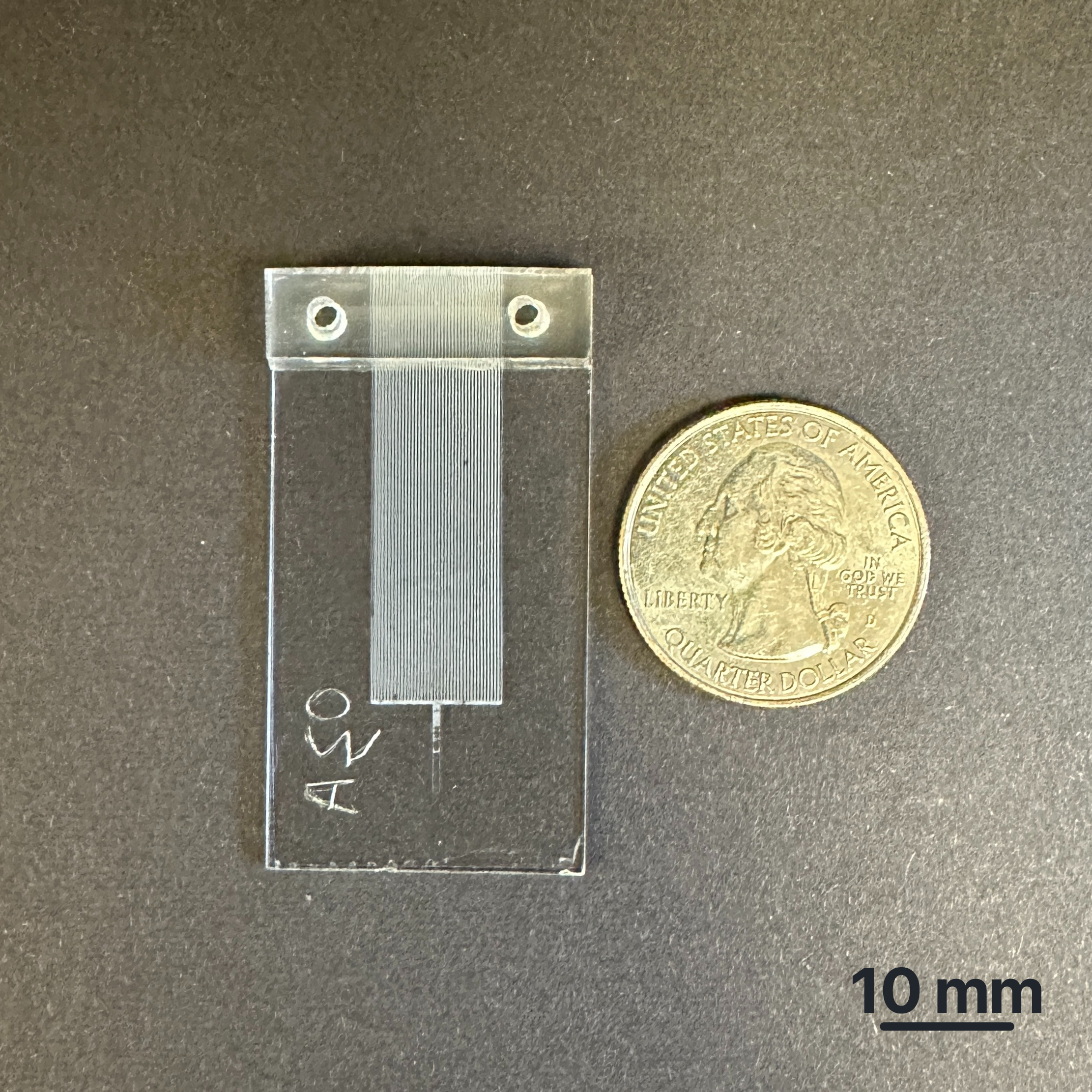
picoTLC device beside a US quarter for scale

picoTLC microchip

picoTLC separation schematic — a single cell is loaded at the origin on the porous microband; its lipids separate toward the solvent front, resolving Compound 1 and Compound 2
The picoGlow Assays

Each picoGlow assay is enabled by a fluorescently labeled enzyme reporter. As the enzyme converts substrate to product, picoTLC separates them, turning activity into a signal we can read in a single cell.

HOW IT WORKS (the SphK assay as an example)
Sphingosine kinase converts the fluorescent substrate Sph-Cy5 into S1P-Cy5; an inhibitor blocks the reaction. Confocal image of fluorescently labeled K562 cells.

Sphingosine kinase phosphorylates Sph-Cy5 into S1P-Cy5. A drug that inhibits the kinase blocks this conversion, so the product never forms.

Control (DMSO)
Drug (1 µM PF543)
Two single-cell separations: a control cell shows both S1P-Cy5 (product) and Sph-Cy5 (substrate) peaks, while a drug-treated cell shows only the Sph-Cy5 peak — the kinase is inhibited.

In a single control cell, both product (S1P-Cy5) and substrate (Sph-Cy5) appear — the enzyme is active. In a drug-treated cell, the product peak is gone: the drug has shut the enzyme down. (Reference)

Our Team

Ming Yao, PhD
Co-Founder & CEO
Scientist trained in engineering & cancer biology; Stanford GSB MBA
Nancy Allbritton, MD, PhD
Co-Founder & Advisor
National Academy of Engineering
National Academy of Inventors
Christopher Sims, MD
Co-Founder & Advisor
Physician, 30+ years translating science to patients
Yuli Wang, PhD
Co-Founder & Advisor
20+ years in biochemical assay & product development
Let's talk.

Pharma wants precise data.
Patients need personalized therapeutics.
Pico Bio is the only one to do just that.

Pco Bio
Supported by non-dilutive NIH grants & SBIR awards